English cinema

Soupçons. Réalisation, Scénario: Alfred Hitchcock, Samson Raphaelson, Joan Harrison, Alma Reville. 1941; 100'. Avec: Joan Fontaine (Lina McLaidlaw), Cary Grant (Johnnie Aysgarth), Sir Cedric Hardwicke (Le général McLaidlaw), Nigel Bruce (Beaky), May Whitty (Mrs. McLaidlaw), Isabel Jeans (Mrs. Newsham), Heather Angel (Ethel), Leo G. Carroll (George Melbec), Auriol Lee (Isobel Sedbusk)
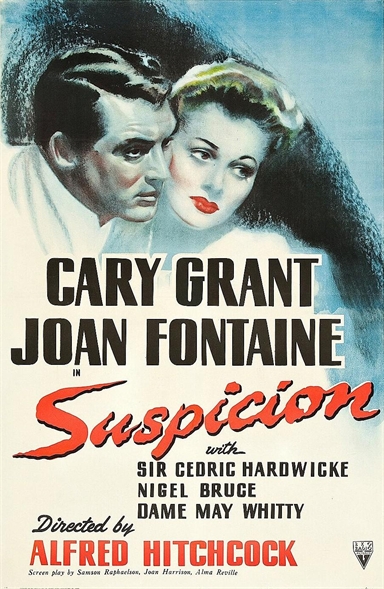
A shy heiress is swept off her feet by a charming, penniless gentleman. Soon after their marriage she suspects he is trying to kill her. Editor Synopsis
Even within a single picture, techniques should vary, although the over-all method of handling the story, the style, must remain constant. It is, for instance, obvious that audience concentration is higher at the beginning of a picture than at the end. The act of sitting in one place must eventually induce a certain lassitude. In order that that lassitude should not be translated into boredom or impatience, it is often necessary to accelerate the progress of the story towards the end, particularly of a long picture. This means more action and less dialogue, or, if dialogue is essential, speeches ought to be short, and a little louder and more forceful than they would be if the same scene were played earlier in the picture. Alfred Hitchcock
L’amour est aveugle, c’est vrai. Mais il arrive parfois que se glisse l’ombre du doute. Et c’est souvent légitime … Même en l’absence de preuve mathématique.
L'Ombre d'un doute. Réalisation, Scénario: Alfred Hitchcock, Sally Benson, Alma Reville, Thornton Wilder. 1943; 108'. Avec: Joseph Cotten (Oncle Charlie Oakley), Teresa Wright (la jeune Charlie Newton), MacDonald Carey (Jack Graham), Patricia Collinge
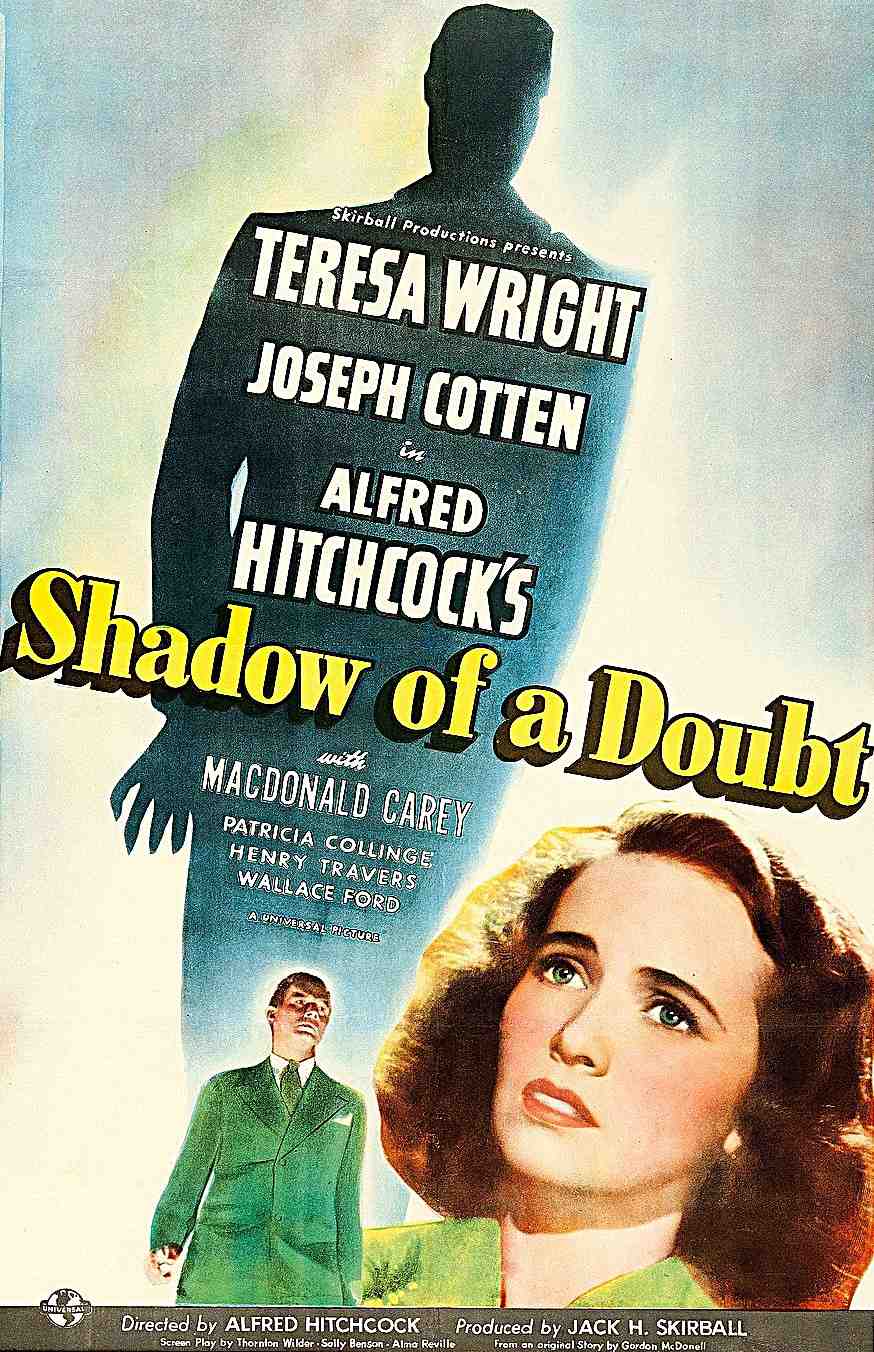
A young woman's loyalties are tested when her uncle arrives for a visit, followed by a detective who suspects him of being a serial killer. Editor Synopsis
-You better go to sleep, baby. You said your prayers? -I forgot.
-You better say them. -I lay me down to sleep. I pray the Lord my soul to keep...
-Don't bless too many people. It's late.
-I pray the Lord my soul to take. God bless Mama, Papa, Captain Midnight, Veronica Lake, and the President of the United States...
-You can't say them all tonight, dear. -Oh, and Uncle Charlie. Amen.
-You better say them. -I lay me down to sleep. I pray the Lord my soul to keep...
-Don't bless too many people. It's late.
-I pray the Lord my soul to take. God bless Mama, Papa, Captain Midnight, Veronica Lake, and the President of the United States...
-You can't say them all tonight, dear. -Oh, and Uncle Charlie. Amen.
-The cities are full of women, middle-aged widows. Husbands dead, husbands who've spent their lives making fortunes, and then they die and leave their money to their wives, their silly wives. And what do the wives do, these useless women? You see them in the hotels, the best hotels every day by the thousands, drinking the money, eating the money, losing the money at bridge, playing all day and all night, smelling of money. Proud of their jewellery, but of nothing else. Horrible, faded, fat, greedy women.
-But they're alive! They're human beings!
-Are they? Are they, Charlie? Are they human, or are they fat, wheezing animals, huh? And what happens to animals when they get too fat and too old?
-But they're alive! They're human beings!
-Are they? Are they, Charlie? Are they human, or are they fat, wheezing animals, huh? And what happens to animals when they get too fat and too old?
What film are you most proud of?
Two films. The first is Shadow of a Doubt, which I wrote with Thornton Wilder. This was one of those rare occasions when suspense and melodrama combined well with character. It was shot in the original town and it had a freshness. Alfred Hitchcock, interview NFT
Two films. The first is Shadow of a Doubt, which I wrote with Thornton Wilder. This was one of those rare occasions when suspense and melodrama combined well with character. It was shot in the original town and it had a freshness. Alfred Hitchcock, interview NFT
En revoyant, posément, ce film j’ai compris pourquoi je n’ai jamais été spécialement fan de films policiers et ce que, inconsciemment, je leur reprochais. Le choix de Shadow of a Doubt par Hitchcock est compréhensible ; c’est un grand film.
National Film Registry US
Les Enchaînés. Réalisation, Scénario: Alfred Hitchcock, Ben Hecht. 1946; 108'. Avec: Cary Grant (TR Devlin), Ingrid Bergman (Alicia Huberman), Claude Rains (Alexander Sebastan), Mme Konstantin (Mrs Anna Sebastian)
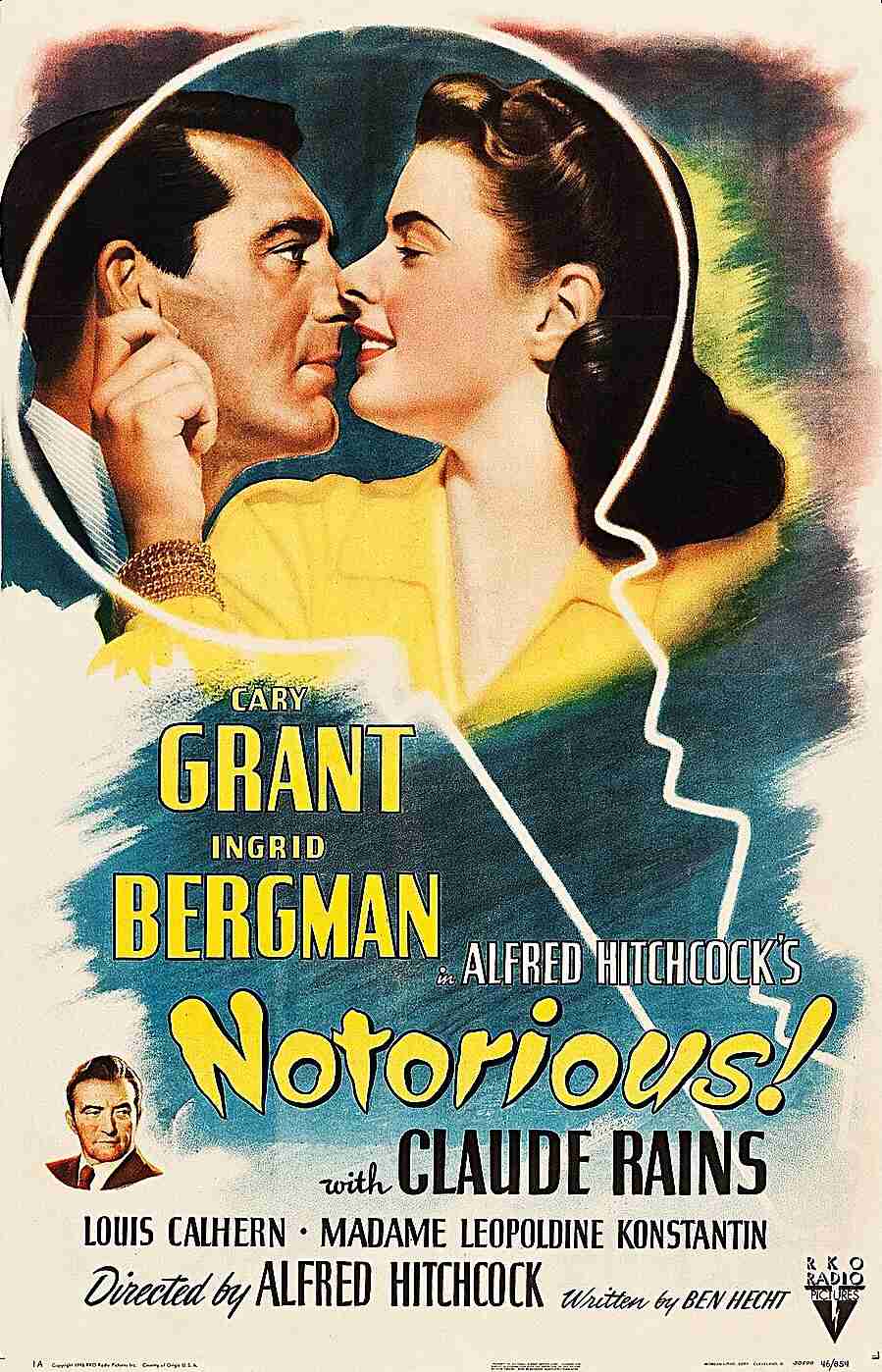
The American daughter of a convicted Nazi spy is recruited to infiltrate a group of Nazi friends who are now living in South America. Editor Synopsis
-After dinner. -No, now. Look, I'll make it easy for you. The time has come when you must tell me that you have a wife and two adorable children and this madness between us can't go on any longer. …
-We have other things to talk about. We've got a job… for you… You remember a man named Sebastian? You've got to work on him and land him.
-Mata Hari. She makes love for the papers. … Did you say anything? I mean, that maybe I wasn't the girl for such shenanigans?
-I didn't say anything. -Not a word for that little lovesick lady you left an hour ago? … Do you want me to take the job?
-You're answering for yourself. -I am asking you. -It's up to you...
-We have other things to talk about. We've got a job… for you… You remember a man named Sebastian? You've got to work on him and land him.
-Mata Hari. She makes love for the papers. … Did you say anything? I mean, that maybe I wasn't the girl for such shenanigans?
-I didn't say anything. -Not a word for that little lovesick lady you left an hour ago? … Do you want me to take the job?
-You're answering for yourself. -I am asking you. -It's up to you...
Notorius pose le problème des sentiments personnels face au Devoir. Truffaut a beaucoup aimé ce film : avec des arguments techniques, il a estimé qu’en utilisant peu d’éléments on arrivait à un maximum de résultats, et que c’était la « quintessence de Hitchcock ».
Le National Film Preservation Board l'a aimé aussi, ou a estimé que l’intérêt supérieur de l’Etat étant au-dessus de l’amour, il fallait conserver cette œuvre à la Bibliothèque du Congrès.
Le National Film Preservation Board l'a aimé aussi, ou a estimé que l’intérêt supérieur de l’Etat étant au-dessus de l’amour, il fallait conserver cette œuvre à la Bibliothèque du Congrès.
National Film Registry US
Le crime était presque parfait. Réalisation, Scénario: Alfred Hitchcock, Frederick Knott. 1954; 105'. Avec: Ray Milland (Tony Wendice), Grace Kelly (Margot Wendice), Robert Cummings (Mark Halliday), John Williams (L'inspecteur Hubbard), Anthony Dawson (le capitaine Lesgate, Swann)
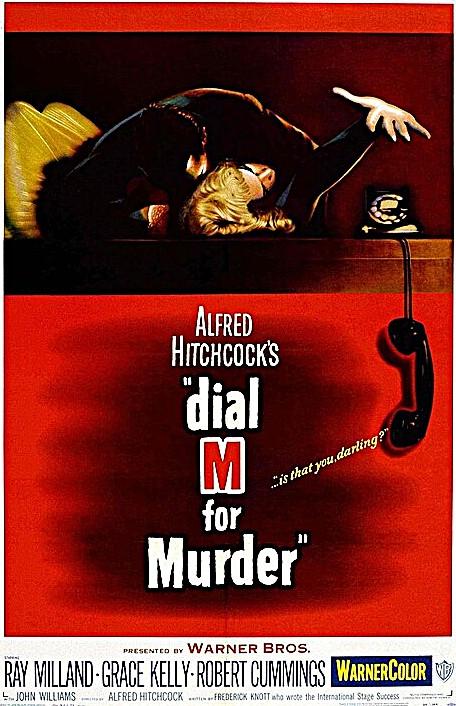
A retired tennis pro carries out an elaborate plot to murder his wife after discovering her affair with a American writer. Editor Synopsis
Dans ce film, Hitchcock fait de la couleur une utilisation particulièrement remarquable. Un exemple : l’épouse infidèle porte une robe rouge. Il n’y a rien d’autre de rouge dans le film jusqu’au moment où l’héroïne comparait devant le tribunal. La caméra alors la cadre en plan rapproché sur fond neutre ; sur ce fond tournoient et se fondent les dominantes du film : le vert qui baignait la préparation du crime, le bleu du crime, puis le rouge qui revient, envahissant tout l’écran, devenant la couleur de l’adultère. François Truffaut
I just did my job, using cinematic means to narrate a story taken from a stage play. All of the action in Dial M for Murder takes place in a living room, but that doesn’t matter. I could just as well have shot the whole film in a telephone booth. Alfred Hitchcock
Adaptation par le maître du policier d’une pièce de théâtre, les règles de la scène ont été respectées comme il tient à le souligner. Et sur le plan moral, il est heureux de voir que les plans machiavéliques ne marchent pas toujours jusqu’au bout.
Fenêtre sur cour. Réalisation, Scénario: Alfred Hitchcock, John Michael Hayes. 1954; 109'. Avec: James Stewart (Jefferies), Grace Kelly (Lisa Carol Fremont), Wendell Corey (Thomas Doyle), Thelma Ritter (Stella), Raymond Burr (Lars Thorwald), Georgine Darcy (Miss Torso), Judith Evelyn (Miss Lonely Hearts), Ross Bagdasarian (compositeur), Jesslyn Fax (Mademoiselle Hearing Aids), Irene Winston (Madame Thorwald)
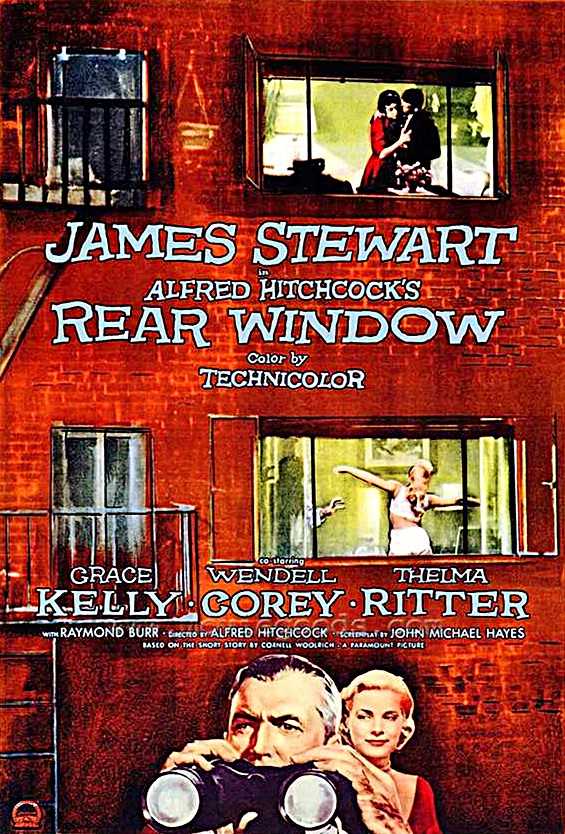
A photographer confined to a wheelchair after an accident spies on his neighbours and suspects one of them is a murderer. Editor Synopsis
-Aayah, Aayay!
-What's the matter? Somebody's hurt? -It's the dog. Something's happened to the dog.
-Which one of you did it? Which one of you killed my dog? You don't know the meaning of the word "Neighbours." Neighbours like each other, speak to each other, care if anybody lives or dies. But none of you do! But I couldn't imagine any of you being so low that you'd kill a little helpless, friendly dog. The only thing in this whole neighbourhood who liked anybody. Did you kill him because he liked you? Just because he liked you?
-What's the matter? Somebody's hurt? -It's the dog. Something's happened to the dog.
-Which one of you did it? Which one of you killed my dog? You don't know the meaning of the word "Neighbours." Neighbours like each other, speak to each other, care if anybody lives or dies. But none of you do! But I couldn't imagine any of you being so low that you'd kill a little helpless, friendly dog. The only thing in this whole neighbourhood who liked anybody. Did you kill him because he liked you? Just because he liked you?
Je pense qu’en travaillant le scénario, vous êtes devenu plus ambitieux; et peu à peu la cour s’est muée pour vous, plus ou moins consciemment, en une image du monde.
It shows every kind of human behaviour, a real index! The picture would have been very dull if we hadn’t done that. What you see across the way is a group of little stories that, as you say, mirror a small universe. Alfred Hitchcock, interviewé par François Truffaut
It shows every kind of human behaviour, a real index! The picture would have been very dull if we hadn’t done that. What you see across the way is a group of little stories that, as you say, mirror a small universe. Alfred Hitchcock, interviewé par François Truffaut
What film are you most proud of?
The other film is Rear Window, which is the most cinematic film I have made. Most people don't realise this because the man is in one room, in one position. But, nevertheless, it's the montage and the cutting of what he sees and its effect on him that creates the whole atmosphere and drama of the film. In other words, the visual transforms itself to emotional ideas. That film lent itself to that. Alfred Hitchcock, interview NFT
The other film is Rear Window, which is the most cinematic film I have made. Most people don't realise this because the man is in one room, in one position. But, nevertheless, it's the montage and the cutting of what he sees and its effect on him that creates the whole atmosphere and drama of the film. In other words, the visual transforms itself to emotional ideas. That film lent itself to that. Alfred Hitchcock, interview NFT
En ces temps-là, l’immobilisation forcée en l’absence de tout l’audiovisuel actuel, entrainait certainement une plus grande attention au voisinage, son spectacle, ses problèmes, …
National Film Registry US
Sueurs froides. Réalisation, Scénario: Alfred Hitchcock, Samuel Taylor. 1958; 128'. Avec: James Stewart (John 'Scottie' Ferguson), Kim Novak (Madeleine Elster / Judy Barton), Barbara Bel Geddes (Midge Wood), Tom Helmore (Gavin Elster)
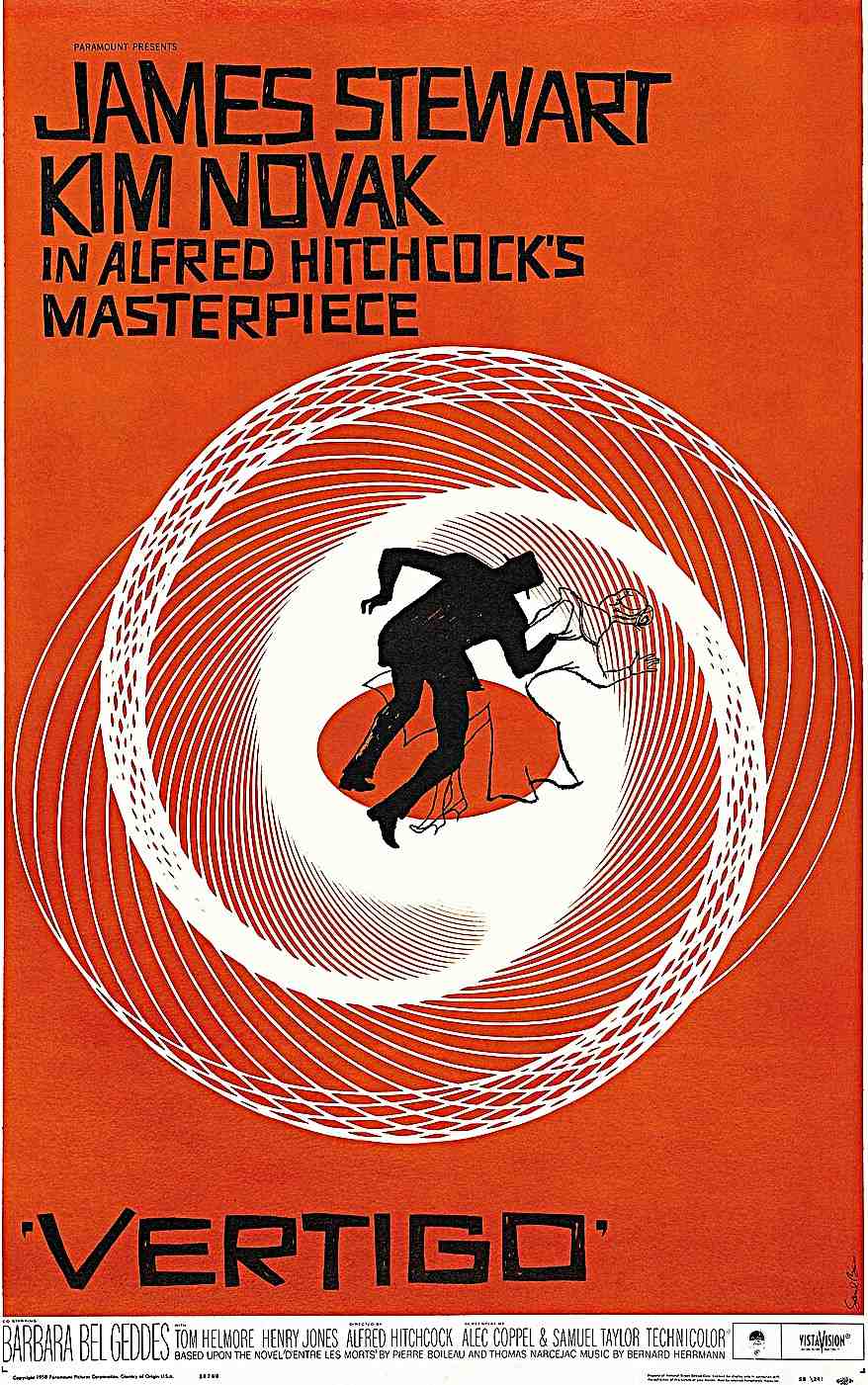
A retired police detective with acrophobia becomes obsessed with a friend's wife while investigating her. Editor Synopsis
-How old? -Some 2000 years or more. -The oldest living things. -Yes. What are you thinking? -Of all the people who've been born and have died when the trees went on living. -Their true name is Sequoia, always green, ever-living. -I don't like them. -Why? -Knowing I have to die... -Here's a cross section of one of the old trees that's been cut down. -Somewhere in here I was born, and there I died. It was only a moment for you, you took no notice.
Un film lent et contemplatif, où l'intrigue et le spectaculaire passent au second plan afin de mettre en relief le trajet mental et physique de la fascination morbide et idéaliste de Scottie pour Madeleine. Scottie aimant littéralement l'image d'une morte, son amour n'existe que parce qu'il ne peut s'accomplir. Il vaudrait mieux dire d'ailleurs que Scottie tombe amoureux de l'histoire de son ami, histoire de réincarnation que l'expérience nous empêche, comme Scottie, de croire. L'atmosphère mythologique du film est admirablement soutenue par la musique néo-wagnérienne de Bernard Herrmann et par la photo de Robert Burks, musique et photo enveloppant chaque plan du film, lui donnant cet aspect liquide qui l'apparente encore davantage à un rêve. Encyclopédie Larousse
After a decade of debate about the justices of cinematic representation, I’d wondered how Hitchcock’s frayed, pessimistic thriller of estrangement would now strike people. Filtering Pygmalion myths of idealisation and exploitation through Proustian memory games, with Bernard Herrmann’s score adding top notes of Wagnerian tragedy, it’s hardly a film that promises hope or amelioration, more a darkly, bottomlessly reflexive portrait of private vices and compulsions; a vortex of perspective-stretching, misdirection and disorientation; a whirlpool of obscure, consuming desire. It seems many of us are still plunging in. British Film Institute
La fascination de la mort, parfois côtoyant les réalités de la vie … Une œuvre souvent citée parmi les grands classiques.
National Film Registry US
La Mort aux trousses. Réalisation, Scénario: Alfred Hitchcock, Ernest Lehman. 1959; 136'. Avec: Cary Grant (Roger Thornhill), Eva Marie Saint (Eve Kendall), James Mason (Philip Vandamm), Martin Landau (Leonard), Leo Carroll (professeur), Jessie Royce Landis (Clara Thornhill)
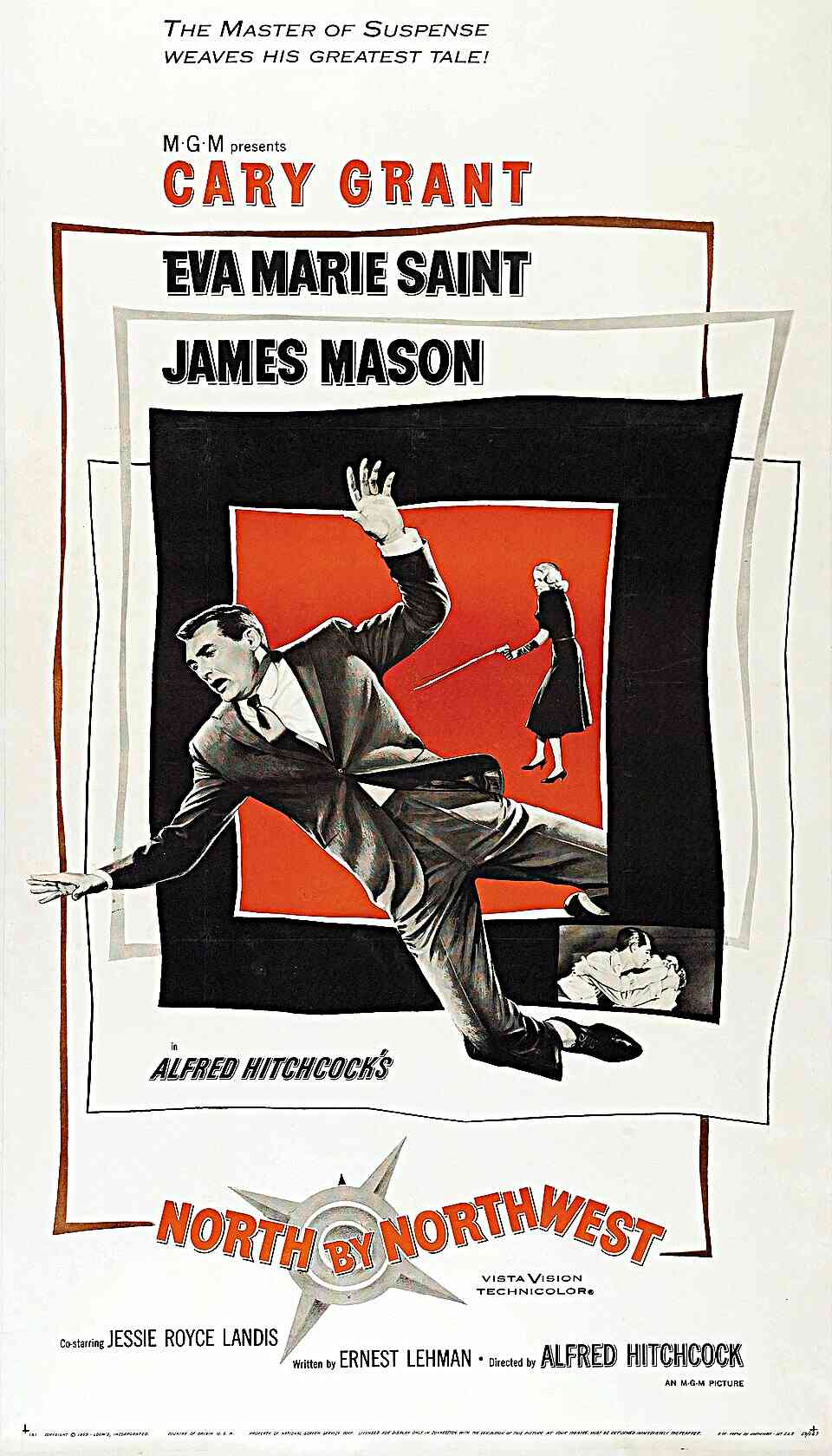
When spies mistake a bewildered New York ad man for a government agent he flees across the country to escape. Editor Synopsis
-Mr Thornhill, my opinion is that you are definitely intoxicated. I won't ask your permission to draw blood. -How disgusting!
-"You may refuse to permit a blood test to be made, but if you do, your license will be revoked."
-"You may refuse to permit a blood test to be made, but if you do, your license will be revoked."
-It was at this point that Mr Thornhill succeeded in escaping from his would-be assassins, and when they gave chase, he, naturally, had to drive as best he could under the circumstances.
-Master, how long have you known your client? -Seven years, Your Honor.
-Do you know him to be a reasonable man? -Absolutely. -Heey...!? -Mother!
-Master, do you believe there is some credence to this story?
-Credence! Yes, Your Honor. If my client says this is what happened, I'm certain it must've happened. -Damn right...
-Master, how long have you known your client? -Seven years, Your Honor.
-Do you know him to be a reasonable man? -Absolutely. -Heey...!? -Mother!
-Master, do you believe there is some credence to this story?
-Credence! Yes, Your Honor. If my client says this is what happened, I'm certain it must've happened. -Damn right...
Do you think people in real life laugh when they are terrorised?
Well, they always come out of the haunted house giggling. They pay money to be scared but always come out laughing. I think the prime example is when it all begins, when a three-month old child is held in its mother's arms and the mother says, "Boo!" The child is startled and gets hiccups but then laughs. Mother laughs too. All seem to be satisfied. Why mother says, "Boo!" to the child, I don't know. But they still do it. Laughter in frightening situations is very common. I remember years ago they used to have the world fair in Islington. It had merry-go-rounds, slides, what have you. In one of the tents, which you paid a penny to go into, there was a man biting the heads off live rats. People were petrified by this situation. But there were two char ladies at the back and one of them, to relieve the tension of the situation, called out, "Don't you want any bread with it?" Hitchcock, interview NFT
Well, they always come out of the haunted house giggling. They pay money to be scared but always come out laughing. I think the prime example is when it all begins, when a three-month old child is held in its mother's arms and the mother says, "Boo!" The child is startled and gets hiccups but then laughs. Mother laughs too. All seem to be satisfied. Why mother says, "Boo!" to the child, I don't know. But they still do it. Laughter in frightening situations is very common. I remember years ago they used to have the world fair in Islington. It had merry-go-rounds, slides, what have you. In one of the tents, which you paid a penny to go into, there was a man biting the heads off live rats. People were petrified by this situation. But there were two char ladies at the back and one of them, to relieve the tension of the situation, called out, "Don't you want any bread with it?" Hitchcock, interview NFT
Le Hitchcock qui fait le plus rire, même si c’est jaune à cause des services secrets. Son décor et sa crédibilité, de l'avis des initiés, ont conquis le National Film Preservation Board.
National Film Registry, US
Psychose. Réalisation, Scénario: Alfred Hitchcock, Joseph Stefano. 1960; 109'. Avec: Anthony Perkins (Norman Bates), Janet Leigh (Marion Crane), Vera Miles (Lila Crane), John Gavin (Sam Loomis), Martin Balsam (Milton Arbogast)
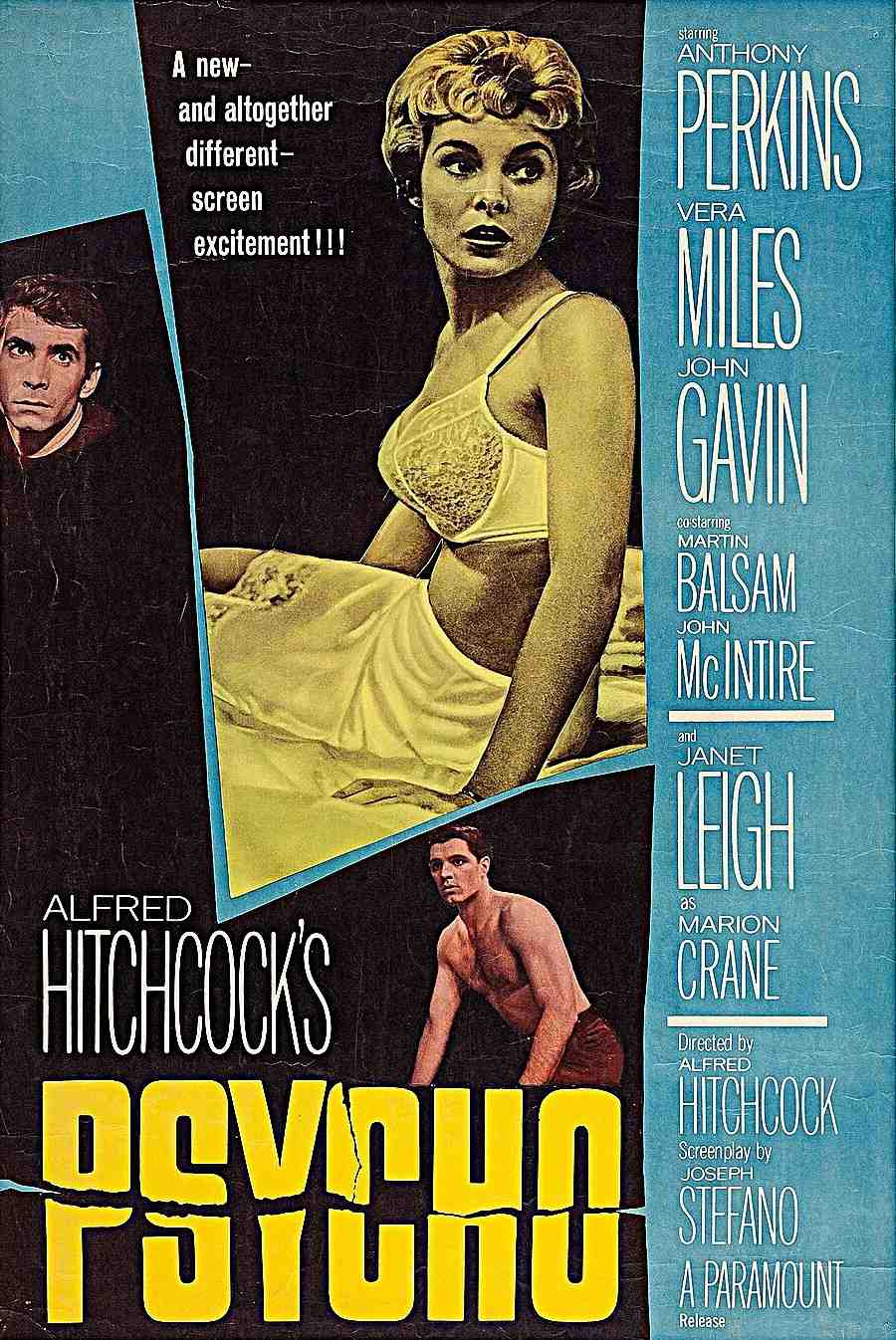
A secretary on the run with stolen money checks into a motel run by a young man dominated by his mother. Editor Synopsis
-Is your time so empty? -No, uh... Well I run the office... You've never had an empty moment in your entire life, have you? -Only my share. -Where are you going? Oh! I didn't mean to pry.
-I'm looking for a private island. -What are you running away from? -Why do you ask that?
-I don't know. People never run away from anything… You know what I think? I think that, we're all in our private traps, clamped in them, and none of us can ever get out. We scratch and claw but, but only at the air, only at each other. And for all of it, we never budge an inch.
-Sometimes we deliberately step into those traps. -I was born in mine. I don't mind it any more.
-Oh but you should. You should mind it…
-I'm looking for a private island. -What are you running away from? -Why do you ask that?
-I don't know. People never run away from anything… You know what I think? I think that, we're all in our private traps, clamped in them, and none of us can ever get out. We scratch and claw but, but only at the air, only at each other. And for all of it, we never budge an inch.
-Sometimes we deliberately step into those traps. -I was born in mine. I don't mind it any more.
-Oh but you should. You should mind it…
In The Birds you have a lot of people killed.
Only four or five. Violence on the screen increases violence in people only if those people already have sick minds. I once read somewhere that a man admitted killing three women and he said he had killed the third woman after having seen Psycho. Well, I wanted to ask him what movie he had seen before he killed the second woman. And then we'd ban that movie, don't you see? And then if we found out that he'd had a glass of milk before he killed the first woman, why then we'd have to outlaw milk, too, wouldn't we? At a screening of Psycho a young boy came up to me, he was about 9 or 10, and he said to me "What did you use for blood, chicken blood?" And I said "No, I used chocolate sauce." And he said "Thank you". The point is that he said what did you use. He knew it was a movie, that it was pretend. Hitchcock, interview H.E.F. Donohue
Only four or five. Violence on the screen increases violence in people only if those people already have sick minds. I once read somewhere that a man admitted killing three women and he said he had killed the third woman after having seen Psycho. Well, I wanted to ask him what movie he had seen before he killed the second woman. And then we'd ban that movie, don't you see? And then if we found out that he'd had a glass of milk before he killed the first woman, why then we'd have to outlaw milk, too, wouldn't we? At a screening of Psycho a young boy came up to me, he was about 9 or 10, and he said to me "What did you use for blood, chicken blood?" And I said "No, I used chocolate sauce." And he said "Thank you". The point is that he said what did you use. He knew it was a movie, that it was pretend. Hitchcock, interview H.E.F. Donohue
Peut-être le plus célèbre des Hitchcock. L’archétype du thriller, et une œuvre forte malgré quelques scènes… un peu dures.
National Film Registry US
Les Oiseaux. Réalisation, Scénario: Alfred Hitchcock, Evan Hunter. 1963; 120'. Avec: Tippi Hedren (Melanie Daniels), Rod Taylor (Mitch Brenner), Suzanne Pleshette (Annie Hayworth), Jessica Tandy (Lydia Brenner), Veronica Cartwright (Cathy Brenner), Ethel Griffies (Mme Bundy), Charles McGraw (Sebastian Sholes), Ruth McDewitt (Mme MacGruder), Elizabeth Wilson (Helen Carter), Lonny Chapman (Deke Carter), Malcom Atterbury (Al Malone), Bill Quinn (Sam)
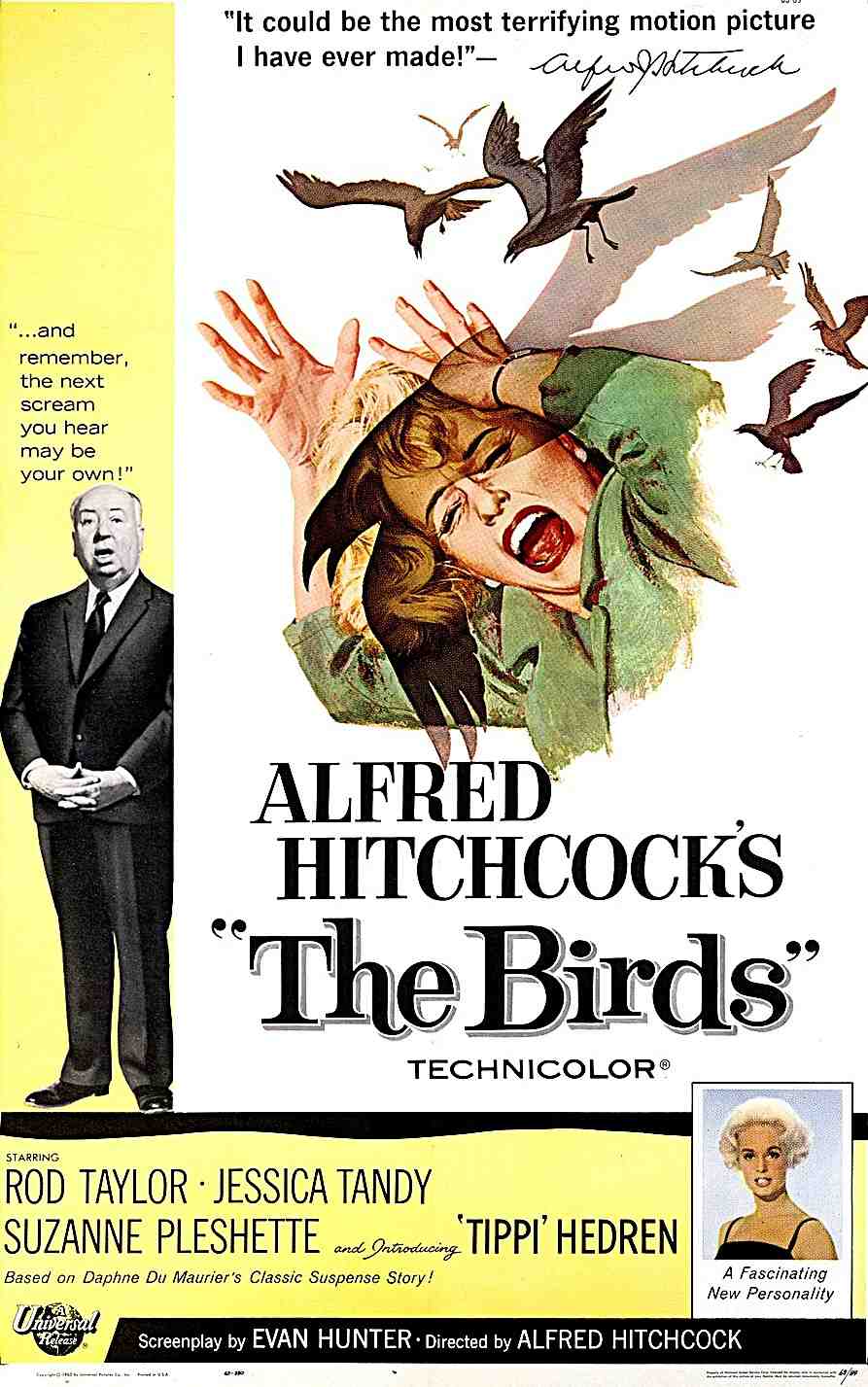
A San Francisco socialite follows her love interest to a California town besieged by bizarre bird attacks. Editor Synopsis
-Birds are not aggressive creatures, miss. They bring beauty into the world. It is mankind, rather, who... insists upon making it difficult for life to exist upon this planet.
-Mrs Bundy, you don't seem to understand. This young lady said the school was attacked.
-Impossible! -Oh, Mitch? Oh, I'm glad I caught you. Something terrible has...
-It's the end of the world! "Thus saith the Lord God unto the mountains and the hills, and the rivers and the valleys. Behold I, even I, shall bring a sword upon you, and I will devastate your high places." Ezekiel, chapter six. -"Woe unto them that rise up early in the morning, that they may follow strong drink." -Isaiah, chapter five. It's the end of the world.
-Could you ask them to lower their voices, please? They're frightening the children.
-Mrs Bundy, you don't seem to understand. This young lady said the school was attacked.
-Impossible! -Oh, Mitch? Oh, I'm glad I caught you. Something terrible has...
-It's the end of the world! "Thus saith the Lord God unto the mountains and the hills, and the rivers and the valleys. Behold I, even I, shall bring a sword upon you, and I will devastate your high places." Ezekiel, chapter six. -"Woe unto them that rise up early in the morning, that they may follow strong drink." -Isaiah, chapter five. It's the end of the world.
-Could you ask them to lower their voices, please? They're frightening the children.
Unique incursion de Hitchcock dans le domaine du pur fantastique, c'est son film le plus angoissant, dans la mesure où le postulat (l'agression des oiseaux) en demeure irrationnel. C'est en même temps le film d'un moraliste impitoyable et d'un technicien (spécialiste de la «direction de spectateur») au sommet de sa maîtrise. Mais les prouesses techniques, utilisant autant des animaux dressés que des effets spéciaux, sont au service d'un propos qui élargit la critique sociale à la réflexion métaphysique. Encyclopédie Larousse
If I had not been what I am, I think I would have preferred to have been a criminal lawyer. That would have been fascinating, finding out about criminals and their crimes, and being a ham actor in court! I have such a dread of the law, you know. Of policemen. I did not drive a car for 11 years after coming to this country for fear of being stopped and given a ticket. Psychiatrists tell me my phobia can be cured, but I doubt it. So many of my pictures have been about wrongly accused men on the run. Hitchcock, interview Roger Ebert
Le crime se résume-t-il au meurtre ? The Birds nous interpelle sur autre chose. Alfred Hitchcock a marqué le policier d’un sceau indélébile, il restera pour les amateurs le maitre du suspense.
Family Life. Réalisation, Scénario: Ken Loach, David Mercer. 1971; 105'. Sandy Ratcliff (Janice Baildon), Bill Dean (son père), Grace Cave (sa mère), Malcolm Tierney (Tim), Hilary Martin (Barbara Baildon), Michael Riddall (le docteur Donaldson)
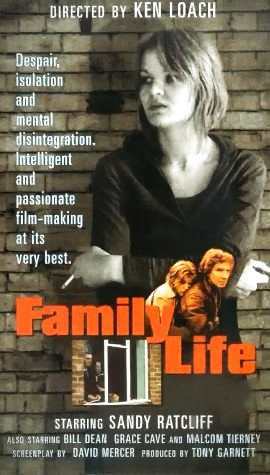
A 19 years old London girl received agressive psychiatric treatments for her schizophrenic behaviour by a doctor who still wants her family to insure the guard of the child without any regards to the facts that it is this family who's agravating her situation. Editor Synopsis
-Come here. Look at that out there. That's your mum and dad. Get that. Early to bed, early to rise, out to work. Do as they're tell. That's what they got to do to you. And that's normal. You see, that's normal. But is it sane? I mean, do you think it's sane? Cause I don't. Punctual. Passive in their place. So that they can go out there, out to one of those factories, and do a day's work. That's what it's about. That's what it is and that's what families are.
-What? -Like bloody training camps. Aren't they? To get you to do the same thing. Where are you in all this? Eh, I mean, where are you? You see, you can't change it. You can put your mark on it.
-What? -Like bloody training camps. Aren't they? To get you to do the same thing. Where are you in all this? Eh, I mean, where are you? You see, you can't change it. You can put your mark on it.
How do you relate this to a consciously political approach?
It’s what you tend to make films about. One thing which I think has been central to the films which we've done has been to try to make films for the class which we think is the only politically important class, the working class, and therefore not to make elitist films, or cineaste films, but to make films which can be understood by ordinary people. Ken Loach, interview JUMP CUT
It’s what you tend to make films about. One thing which I think has been central to the films which we've done has been to try to make films for the class which we think is the only politically important class, the working class, and therefore not to make elitist films, or cineaste films, but to make films which can be understood by ordinary people. Ken Loach, interview JUMP CUT
L’échec des enfants, et il s’agit d’un majeur ici au point de pouvoir parler de désastre, interroge et pousse à chercher des remèdes. Le plus indiscutable ici se situe au niveau de l’état, qui doit reformer et améliorer son système de soins, et ceci ne concerne pas seulement les Anglais. Un autre niveau est la famille, et là on est dans le discutable. Est-ce propre à un milieu? Des parents qui ont tout fait dans la voie qu’ils estimaient être bonne peuvent-ils être chargés de quoi que ce soit? Faut-il instaurer l’éducation des futurs parents à leurs responsabilités? Même dans ce dernier cas, est-on sûr d’améliorer significativement les choses?
Secret Défense. Réalisation, Scénario: Ken Loach, Jim Allen. 1990; 108'. Avec: Brian Cox (Peter Kerrigan), Frances McDormand (Ingrid Jessner), Brad Dourif (Paul Sullivan), Mai Zetterling (Moa), Bernard Bloch (Henri), Maurice Roëves (Harris), Robert Pattinson (Ian Logan), Jim McAllistair (Liam Philbin)
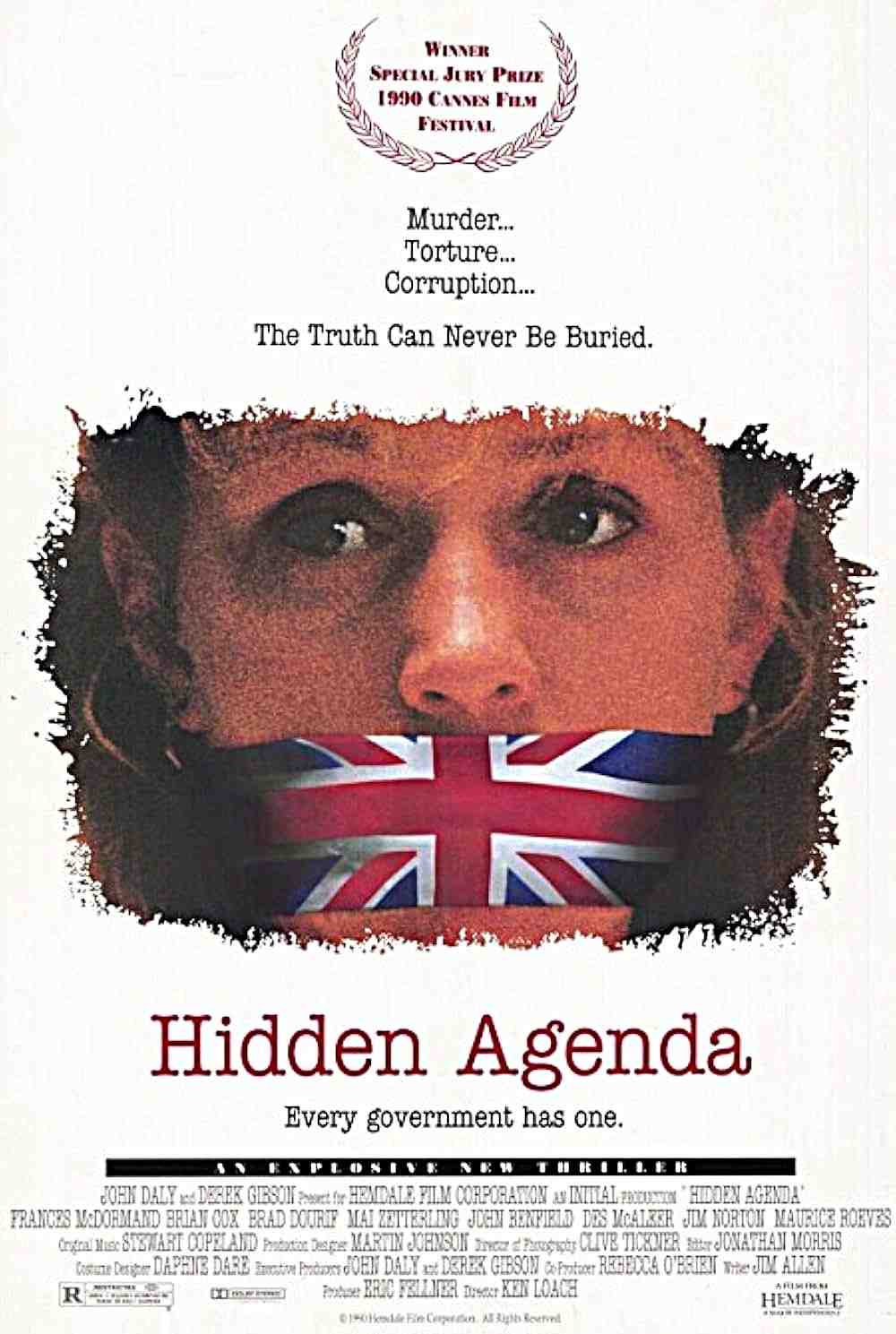
In Ireland, an American lawyer and her activist partner, struggle to uncover atrocities committed by the British government against the Northern Irish during the “Troubles.”
Editor Synopsis
Editor Synopsis
-Also, I'll need a car... ...without a driver. -You realize that I can't guarantee your safety?
-Absolutely. -Just let me say one thing, so there can be no misunderstanding. When you have completed your inquiry, you will deliver your report to me first.
-I understood it was to go to the DPP first. -No, it comes to me first. I will forward it to the Director of Public Prosecutions. That is the constitutional position.
-Absolutely. -Just let me say one thing, so there can be no misunderstanding. When you have completed your inquiry, you will deliver your report to me first.
-I understood it was to go to the DPP first. -No, it comes to me first. I will forward it to the Director of Public Prosecutions. That is the constitutional position.
In the Maidstone and the Maze/ I thought about my land/ throughout these days/ Why my country was divided/ Why I was now in jail/ Imprisoned without crime or without trial/ And now I love my country/ I've seen cruelty and injustice at first hand/ And then one fateful mornin'/ I shook bold freedom's hand/ For right or wrong, I tried to free my land/ And you dare call me a terrorist.
While you look down your gun/ When I think of all the deeds/ that you have done/ You have plundered many nations/ divided many lands/ You have terrorized their people/ You've ruled with an iron hand/ And you've brought this reign of terror/ to my land/ And you dare call me a terrorist. From Joe McDonnell, song
While you look down your gun/ When I think of all the deeds/ that you have done/ You have plundered many nations/ divided many lands/ You have terrorized their people/ You've ruled with an iron hand/ And you've brought this reign of terror/ to my land/ And you dare call me a terrorist. From Joe McDonnell, song
Ils ont éliminé les patriotes, et divisé tellement de pays! Les Anglais, mais aussi d’autres impérialistes…
Et ils continent à œuvrer à la dislocation de tellement de pays!
Et ils continent à œuvrer à la dislocation de tellement de pays!
Prix du Jury Cannes
Réalisation, Scénario: Ken Loach, Jim Allen. 1993; 90'. Avec: Bruce Jones (Bob), Julie Brown (Anne), Gemma Phoenix (Coleen), Ricky Tomlinson (Tommy), Tom Hickey (le père Barry)
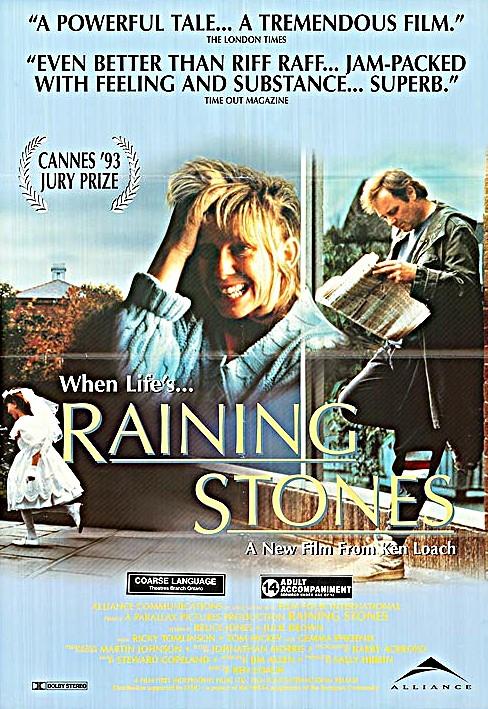
A religious and poor man intends on earning enough cash to buy a new communion dress for his daughter.
-The reason he had all his mates round for this tea was because he knew he was going to die.
-How did he know? -Well, because he's Christ. Christ knows everything!
-Why couldn't he run away? -Oh, bloody hell! Don't they teach you anything at school? ... Picks up His cup, "This is my blood." -Yeah, but I don't want to drink Christ's blood!
-It's not real blood! … Do you understand now? -No
-When you die, you go to heaven. If you've not had your Holy Communion you can't get in. Do you understand me? -No. … -Oh, bloody hellfire!
-How did he know? -Well, because he's Christ. Christ knows everything!
-Why couldn't he run away? -Oh, bloody hell! Don't they teach you anything at school? ... Picks up His cup, "This is my blood." -Yeah, but I don't want to drink Christ's blood!
-It's not real blood! … Do you understand now? -No
-When you die, you go to heaven. If you've not had your Holy Communion you can't get in. Do you understand me? -No. … -Oh, bloody hellfire!
-Look, I got myself in this mess, I'll get myself out. -Not through the church you won't, son.
-What's the church got to do with it? -You're looking for answers and there isn't any because they're part of the problem. -Look, you've got your beliefs, I've got mine, OK?
-No, what you've got is fear… All this religious mumbo-jumbo all it does is tire your mind and stops you thinking for yourself.
-Look, Jimmy, the last thing I need right now is a lecture. Or a sermon.
-No, what you need is a job and there aren't any. And, when you're a worker, it rains stones seven days a week.
-What's the church got to do with it? -You're looking for answers and there isn't any because they're part of the problem. -Look, you've got your beliefs, I've got mine, OK?
-No, what you've got is fear… All this religious mumbo-jumbo all it does is tire your mind and stops you thinking for yourself.
-Look, Jimmy, the last thing I need right now is a lecture. Or a sermon.
-No, what you need is a job and there aren't any. And, when you're a worker, it rains stones seven days a week.
On sourit, on hoche la tête. On rit … Et on se reprend vite.
Toute la peine et la tragédie de ceux dont le Labour Party est sensé améliorer la condition.
Toute la peine et la tragédie de ceux dont le Labour Party est sensé améliorer la condition.
Prix du Jury Cannes, Meilleur Film Etranger FR, BE
Réalisation, Scénario: Ken Loach. 1995; 109'. Avec: Ian Hart (David Carr), Rosana Pastor (Blanca), Icíar Bollaín (Maite), Tom Gilroy (Lawrence), Marc Martínez (Vidal), Frédéric Pierrot (Bernard)
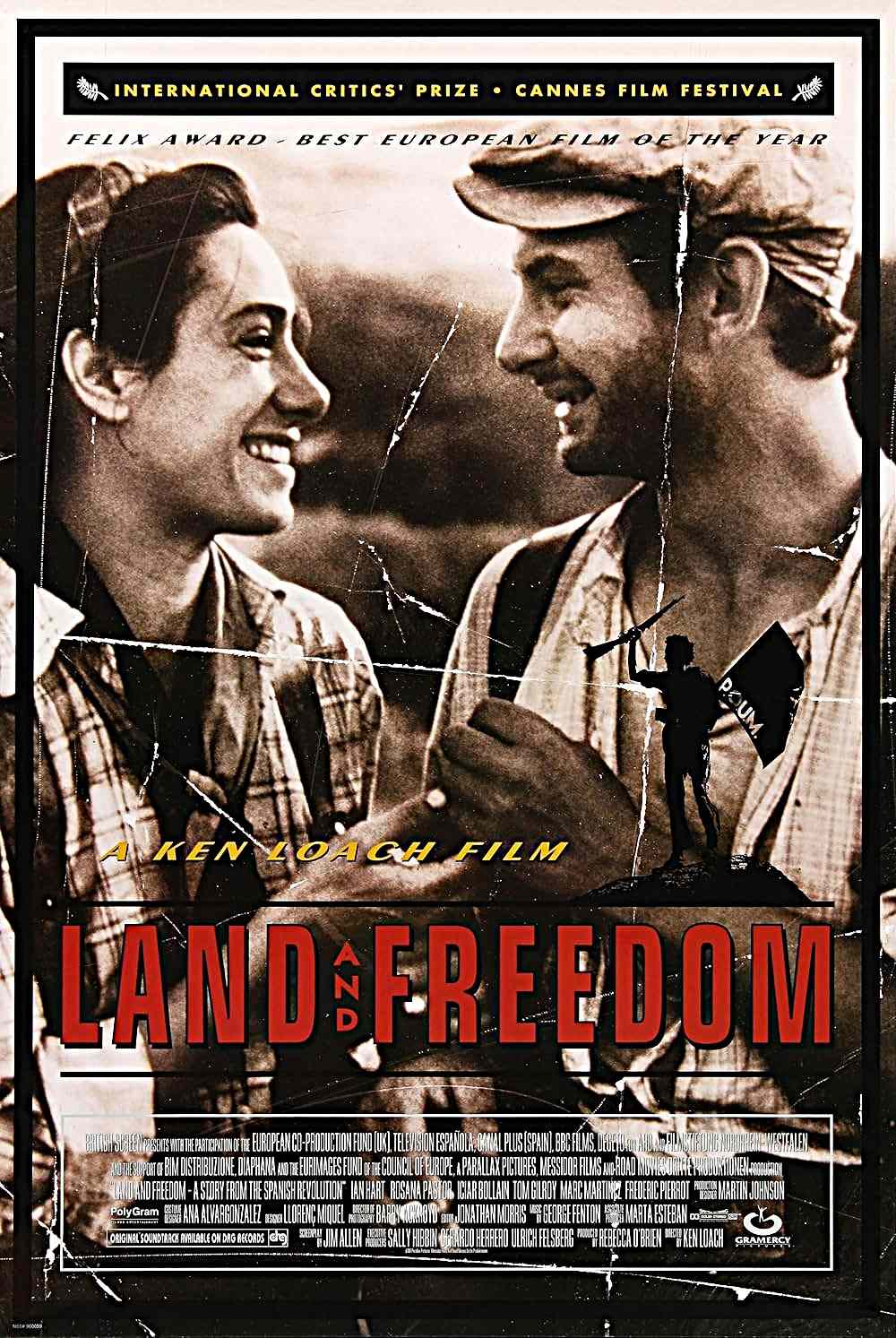
In 1936, a disillusioned Liverpudlian decides to follow his principles and join the fight against fascism in Spain. Taking up with a poorly armed Republican alliance, he soon becomes enmeshed in the desperate struggle to protect the country's democratic government from General Franco's advancing armies. Editor Synopsis
-I'm going to Spain. -What, just like ... ? Why you? Why have you got to go?
-Because I can. I haven't got any kids or nothing. What am I doing here, Kit? I'm on fifteen bob a week on the dole. I know, there's millions of us, out of work. I'm on, you know, demonstrations, hunger marches just...
-I know. I've been there with you. -I know. But I want to do something.
-And you can't do it here? -If we've got to do it, we've got to do it now. We've got to stop them. Otherwise it's not, it's going to be too late, Kit. We'll have no future here.
-Because I can. I haven't got any kids or nothing. What am I doing here, Kit? I'm on fifteen bob a week on the dole. I know, there's millions of us, out of work. I'm on, you know, demonstrations, hunger marches just...
-I know. I've been there with you. -I know. But I want to do something.
-And you can't do it here? -If we've got to do it, we've got to do it now. We've got to stop them. Otherwise it's not, it's going to be too late, Kit. We'll have no future here.
La guerre d'Espagne fit plus d'un million de victimes : 145 000 morts, 134 000 fusillés, des représailles inexpiables des deux côtés, 630 000 morts de maladie. Plus de 400 000 Espagnols s'exilèrent ; le régime franquiste s'installa dans un pays ruiné. Encyclopédie Larousse
L’apôtre des classes populaires sort ici de ses îles pour se pencher sur un évènement majeur de l’histoire du XXe siècle.
La Revolution Espagnole fut combattue par la bourgeoisie et son bras armé, le général Franco. Le Front Populaire avait les Milices Espagnoles et les Brigades Internationales formées de plus de 40 000 progressistes venus de France, des USA, du Canada et d’autres pays d’Europe. L’échec de la Revolution Espagnole est dû à ses divisions internes qui ont permis aux troupes fascistes soutenues par l’Axe de l’emporter. Ouvrant la voie aux agressions fascistes ultérieures.
La Revolution Espagnole fut combattue par la bourgeoisie et son bras armé, le général Franco. Le Front Populaire avait les Milices Espagnoles et les Brigades Internationales formées de plus de 40 000 progressistes venus de France, des USA, du Canada et d’autres pays d’Europe. L’échec de la Revolution Espagnole est dû à ses divisions internes qui ont permis aux troupes fascistes soutenues par l’Axe de l’emporter. Ouvrant la voie aux agressions fascistes ultérieures.
OCIC, FIPRESCI Cannes, Meiilleur Film Européen EU, Meiilleur Film Etranger FR
Réalisation, Scénario: Ken Loach, Paul Laverty. 2004; 104'. Avec: Atta Yaqub (Casim Khan), Eva Birthistle (Roisin Hanlon), Ahmad Riaz (Tariq Khan), Shamshad Akhtar (Sadia Khan), Shabana Akhtar Bakhsh (Tahara Khan), Ghizala Avan (Rukhsana Khan)
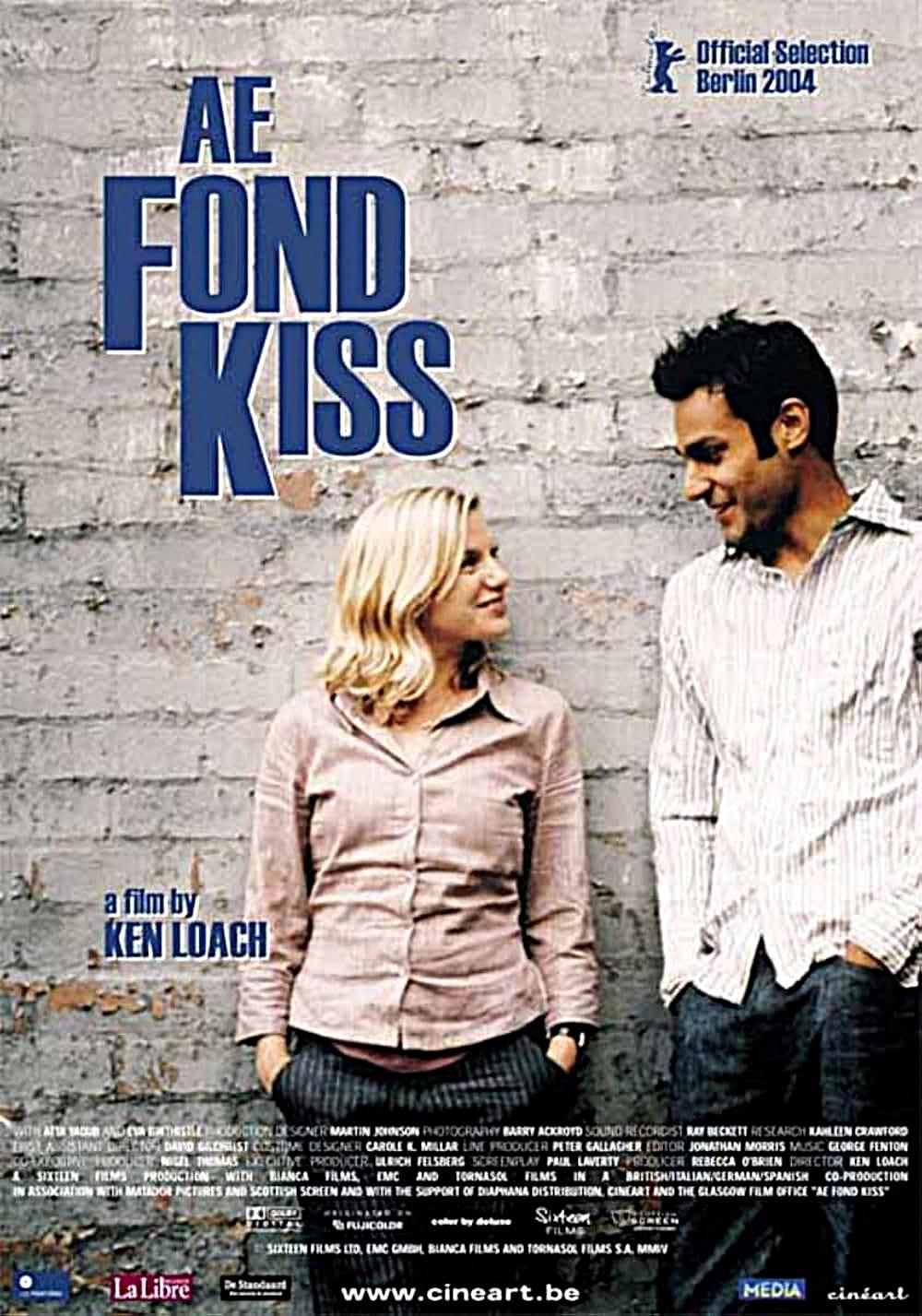
A young man upsets his Punjabi family when he falls in love with an Irish schoolteacher. Editor Synopsis
-Hey, missus! …
-I reject the West's definition of terrorism, which excludes the hundreds of thousands of victims of state terror. I reject the West's claim of moral high ground after two of its main Jesus-lovers tore up the UN charter. But above all... I reject the West's simplification... of a Muslim. I am a Glaswegian... Pakistani, teenager, woman. of Muslim descent... who... supports... Glasgow Rangers in a Catholic School. Cos I'm a dazzling mixture and I'm proud of it.
-I reject the West's definition of terrorism, which excludes the hundreds of thousands of victims of state terror. I reject the West's claim of moral high ground after two of its main Jesus-lovers tore up the UN charter. But above all... I reject the West's simplification... of a Muslim. I am a Glaswegian... Pakistani, teenager, woman. of Muslim descent... who... supports... Glasgow Rangers in a Catholic School. Cos I'm a dazzling mixture and I'm proud of it.
It was in a cultural area I'd never worked in before. And I was keen to explore it.
Ken Loach
Ken Loach
L'amour peut escalader beaucoup de murs. Les abattre, définitivement, est un autre problème que le temps finira, j’en suis persuadé, à résoudre.
Un regard positif, non romanesque, sur une autre réalité britannique… et occidentale.
Un regard positif, non romanesque, sur une autre réalité britannique… et occidentale.
OCIC Berlin, Meiilleur Film Etranger FR